Education that adapts
as quickly as the
industries it serves

Real-Time Learning  |  Real-World AI

RIT Certified teaches AI through real work—helping professionals and employers apply it to practical workflows. With hands-on learning, an evolving curriculum, and tailored employer solutions, we help teams keep pace with change and build capability.

How AI Shows Up in Our Work

Our work brings AI into applied workflows, supports a living education model, and creates tailored solutions for employers.

Applied AI Learning
We teach AI through real tasks like messaging, storytelling, iteration, and content development so it can be applied directly to work.
+
A Living Education Model
Our curriculum evolves continuously through changes in AI, employer input, and practitioner insight, helping it stay current and relevant.
+
Employer Solutions
We partner with companies and organizations to create bespoke training, workflow-specific AI use cases, and practical adoption support.

Where We’re Starting

We are starting with creative workflows. Generative AI is already changing how work gets done across marketing, communications, design, and related fields. Teams are using AI to support concept development, messaging, content creation, research, iteration, and production.

At RIT Certified, creative workflows are a practical starting point for applied AI learning because they are visible, collaborative, and closely tied to real business outcomes. What we learn here also helps inform how applied AI education can expand into other industries and employer contexts.

Why start with creative workflows?

  • High visibility of change
    AI adoption is especially noticeable across marketing, communications, design, and media.
  • Strong demand
    Employers and professionals want practical ways to apply AI directly in day-to-day work.
  • Cross-functional value
    Creative workflows span disciplines, making them ideal for demonstrating applied AI.
  • A scalable model
    What we learn here can help shape a framework for other industries and employer needs.
Brief Development
Personas & Processes
Content Creation
Presentation Prep
Lexicon Building
Pitching & Persuasion
Storytelling
Copywriting
Branding
Market Research
Campaign Development
Leadership & Motivation
MESSAGING
EXPERIENCE DESIGN
DESIGN ITERATION
Journey Mapping
Visual Storyboarding

Targeted Workflows

A creative workflow is a series of steps that moves a team from idea to execution. By mapping these workflows, we can identify where AI can support the work, where human judgment matters most, and how applied AI skills can transfer across roles and industries.

INFORMED by Research
Increasing icon
Analysis of more than 44,000 U.S. job postings since 2021 shows rising demand for skills that combine generative AI with creative problem solving, copywriting, and design.
Workflow icon
Mapping of 22 distinct creative workflows such as campaign development, storytelling, prototyping, and media production revealed where AI skills are being integrated into day-to-day practice.
Raise icon
Salary data also indicates that creative roles requiring AI skills command a premium, underscoring how employers value professionals who can apply AI in context.
Our approach is informed by labor market analysis and workflow mapping conducted by our team using Lightcast labor market analytics. This work has helped identify how AI is being integrated into creative roles, where skills are shifting, and why applied learning matters.

Work-Integrated Learning

  • Learning by doing
    Learners strengthen best practices while integrating AI directly into real workflows. The approach is applied, not isolated, and designed to evolve as tools and industry needs change.
  • Led by practitioners
    Developed and taught by working professionals, with curriculum shaped by real workflows, current tools, and employer-informed outcomes.
  • Grounded in the field
    Industry partners and alumni contribute real-world scenarios, examples, and use cases—ensuring the learning is relevant and transferable back to the job.
  • Connected to RIT
    RIT faculty perspectives and our applied learning heritage add rigor and context, linking industry practice to effective skill-building.

The Living Education Model in Action

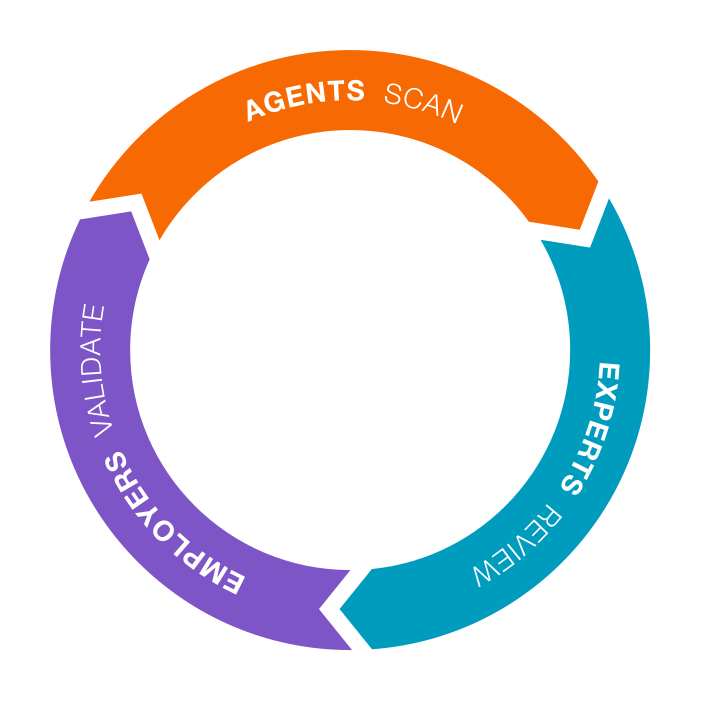
Traditional curriculum may update every couple of years. Our model evolves continuously to match the pace of industry change. We treat education as a living system:

  • AI agents scan for emerging AI tools, practices, and trends.
  • Experts review what matters and translate it into practical learning updates.
  • Employers validate outcomes against real-world challenges and workforce needs.

Then we update the curriculum and repeat—so learning stays current as tools and workflows evolve.

This creates shorter, high-impact learning cycles that fit professional life. Learners don’t just encounter new tools—they apply them in context to strengthen workflows, decision making, communication, leadership, and problem solving. We also capture what learners use and where workflows shift, then refine cases, tools, and exercises in an ongoing cycle.

Professionals can return to refresh and build over time, staying current, adaptable, and ready to lead in a fast-changing world.

Living education model
Creative team

Custom Employer Solutions

For employers, our work goes beyond courses. We design applied AI solutions that address real business needs, including:

  • Bespoke training aligned to workforce priorities and real workflows
  • Custom AI agents tailored to specific use cases and team needs
  • Adoption support through short trainings, step-by-step guides, and regular update cycles

An Emerging Example

The Challenge
A major employer has senior leaders with decades of knowledge nearing retirement. Their departure risks the loss of critical insights, practices, and institutional memory that define the brand.
The Opportunity
AI agents can help capture and organize this expertise—transforming it into a searchable, usable resource that supports faster onboarding, stronger collaboration, and better decision making.
The Solution
By pairing tailored training with workflow-specific AI agents, the organization can preserve institutional knowledge, strengthen workforce capability, and maintain continuity while enabling innovation.
The Broader Need
Many organizations face similar risks when essential knowledge lives in people’s heads instead of systems. Applied AI—combined with training and adoption support—can help make expertise easier to retain, share, and scale.